Backing the Science Behind Reusable Spacecraft
For years we’ve argued that the space industry’s single-use default is unsustainable — not just environmentally, but economically and strategically. Today we’re proud to share research that puts rigor behind that conviction.
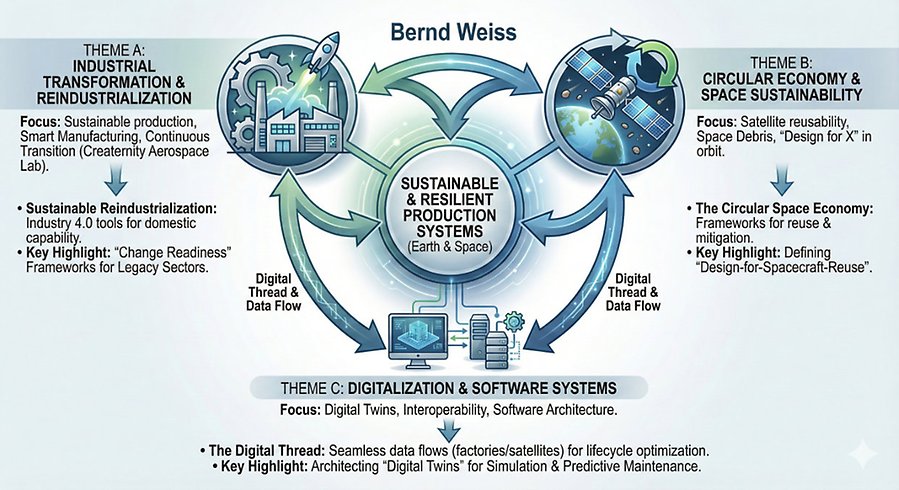
Bernd Weiss, our senior advisor, has completed his doctoral thesis, Design for Spacecraft Reuse: A Systems Perspective on Circularity in Space, at Luleå University of Technology. We’re glad to have supported this work, because its findings speak directly to the systems we’re building.
Find the thesis here: https://lnks.at/phd-dfsr-circularspaceeconomy-weiss
The thesis introduces DfSR — Design-for-Spacecraft-Reuse — a framework for embedding circularity into spacecraft from the earliest design decisions. Its central insight reframes a problem the whole industry is wrestling with: reuse is not universal. Where a satellite operates determines how it can be reused. Spacecraft in low Earth orbit, geostationary orbit, and beyond each demand fundamentally different design logic. Treating reuse as one problem is why so many efforts stall.
This matters far beyond academia. Orbital debris is borderless, cascading, and effectively permanent — and the orbital commons now underpins the global economy. Designing for reuse isn’t an environmental nicety; it’s infrastructure resilience.
Bernd defends the thesis publicly on 17 June 2026, livestreamed from Luleå. It’s open to anyone working on, or curious about, the future of sustainable space operations.
We’ll share the link to join soon. For now, we’re simply proud to have backed work that asks the right question: not how we clean up after spacecraft, but how we design them never to become waste.